Many cryptocurrency investors are often unsure about whether they need to report their crypto transactions, especially if the amount involved is under $600. The short answer is: Yes, you still need to report your crypto transactions, even if the total is under $600. Here’s a breakdown of why and how you should report crypto, no matter the amount.
5-star rated20+ years in NYCAll 50 statesEvenings & weekends
12+
Years Serving NYC
50
States Covered
5★
Rated on Yelp
150,000+
Returns Filed
Open
Evenings & Weekends
Quick summary
There is a rumor floating around that if your crypto transactions are under $600, you do not have to report them. That is not true. The IRS expects you to report every sale, trade, and spend, no matter how small.
Here is where the confusion comes from and what you actually need to do.
Section 01
Where Did the $600 Rule Come From?
A few years ago, Congress passed a law that requires payment platforms like PayPal, Venmo, and Cash App to send tax forms to anyone who receives over $600 for goods or services. That is a reporting requirement for the platform, not a free pass for you.
If you sell a couch on Facebook Marketplace and get paid through PayPal, PayPal sends you a 1099-K if the total goes over $600. That is the rule people have heard about.
But crypto is different. The IRS treats crypto as property, not currency. The $600 threshold for payment platforms does not apply to crypto trades or sales. There is no minimum amount that lets you off the hook.
Section 02
What Transactions Do I Have to Report?
All of them. Seriously.
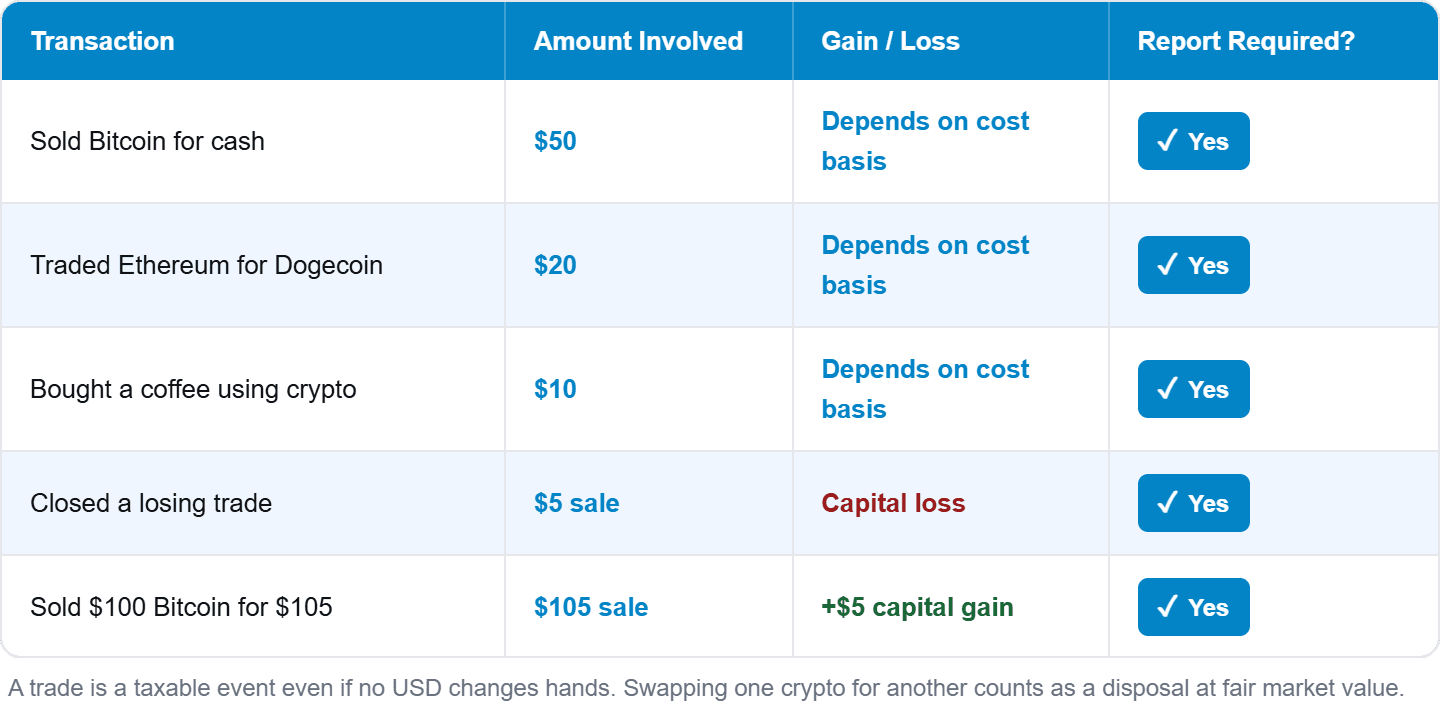
If you sold $50 worth of Bitcoin, report it.
If you traded $20 of Ethereum for Dogecoin, report it.
If you spent $10 in crypto on a coffee, report it.
If you lost money on a $5 trade, report it.
There is no "too small to matter" exception. The IRS asks the crypto question on the front page of your tax return. If you check "yes" and then leave off a bunch of small transactions, you are asking for trouble.
Section 03
What If I Only Made a Few Dollars?
Still report it.
Let us say you bought $100 of Bitcoin, sold it for $105, and made $5. That is a $5 capital gain. You owe tax on that $5. The tax might be a dollar or two. But the IRS still wants to know about it.
The penalty for failing to report is based on the tax owed, not the transaction size. For small amounts, the penalty is small. But if you get audited and the IRS sees unreported transactions, even small ones, they start asking questions about everything else.
Section 04
What If I Lost Money?
Report it anyway.
If you bought $100 of crypto and sold it for $80, you have a $20 capital loss. That loss can offset other gains. If you do not report it, you lose that benefit. And if the IRS finds the transaction on an exchange report, they will tax you on the full sale amount without giving you credit for what you paid.
That is worse than reporting it. You end up paying tax on money you never actually made.
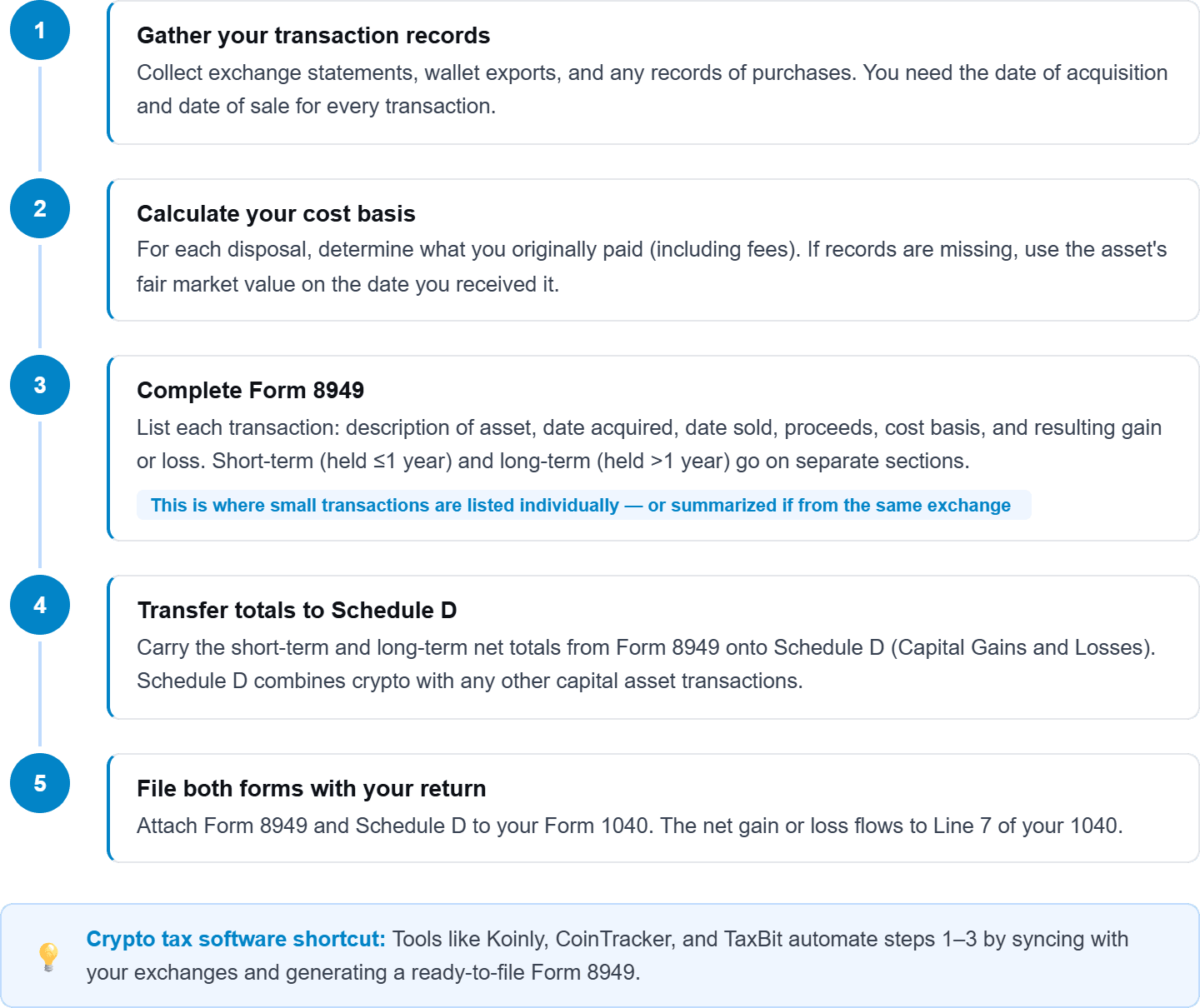
You list each transaction: date acquired, date sold, cost basis, sale price, gain or loss.
If you have many small transactions, you can summarize them. But the information still has to be there. Most crypto tax software will handle this automatically. You connect your exchange accounts, and the software generates the forms.
Section 06
What If I Used an Exchange That Did Not Send Me a Form?
Does not matter. You still have to report.
Many crypto exchanges do not issue 1099 forms. Some issue them only for certain types of transactions. The absence of a form does not mean the transaction is off the record. The IRS can still get exchange data through subpoenas or information-sharing agreements.
If you traded on a platform that does not report to the IRS, you are still responsible for reporting your own transactions. Ignorance is not a defense.
Section 07
What Happens If I Do Not Report Small Transactions?
The IRS may never notice. But they might.
The agency has been ramping up crypto enforcement. They have hired outside firms to analyze blockchain data. They send letters to taxpayers whose exchange records do not match their tax returns.
If you get one of those letters, you will have to explain why you did not report certain transactions. If the amounts are small, you will probably just pay the tax and a small penalty. But you will also spend hours dealing with the letter, pulling records, and responding.
Is it worth saving a few dollars in tax? Usually not.
Section 08
Q&A
Q: Do I have to report crypto if I made less than $600 total?
A: Yes. There is no threshold. All sales, trades, and spends are reportable.
Q: Do I have to report crypto if I lost money?
A: Yes. Losses are reportable. They may offset other gains or reduce your ordinary income.
Q: Does the $600 rule for PayPal apply to crypto?
A: No. That rule is for payment platforms processing goods and services. Crypto trades are not covered by that threshold.
Q: Do I need to report crypto I received as a gift?
A: If you received crypto as a gift, you do not owe tax at the time of receipt. But when you later sell or trade it, you report the transaction using the giver's cost basis.
Q: What if I cannot figure out my cost basis for an old transaction?
A: Do your best. Use the price on the date you think you bought it. If you have no records, the IRS will assume your basis is zero, meaning the entire sale price is gain. That is why keeping records matters.
There is no $600 exemption for crypto transactions. The IRS expects you to report every sale, trade, and spend, regardless of the amount. Small transactions might seem like a hassle, but ignoring them can lead to IRS notices, penalties, and a lot of wasted time.
Keep records. Use software if you have many transactions. Report everything. It is not worth the risk to leave things off.
No cost to start
Questions about your specific situation?
Fifteen minutes with a CPA who handles this every week. We will walk you through your options — no sales pitch, no obligation.
“George has prepared and maintained the corporate accounting and provided consultant services for my company for a number of years. He has always done an outstanding, professional and courteous job. I feel that his rates are very fair and he provides a great value for the cost.”
Alfonso V.
“Excellent service and very professional. George and his team have been handling my business taxes for years and I couldn't be happier with the results. They are always available to answer questions and provide expert advice.”
Michael R.
“I've been working with Dimov CPA for both personal and business taxes. Their attention to detail and knowledge of tax law has saved me thousands. Highly recommend to anyone looking for a reliable CPA in NYC.”