Get expert tax and accounting help!Call(212) 641-0673
401k limits
Tax Strategy & Planning

401(k) excess contribution: how to fix it before April 15

Contributed too much to your 401(k)? What counts as an excess deferral, how a mid-year job change causes one, and what changes in 2026 for higher earners.

  • The deadline is April 15 following the year of the excess. Miss it and pre-tax money is taxed twice, with the 10% early distribution tax possible on top.
  • A mid-year job change causes an excess, because each employer tracks the limit separately and neither sees the other's total.
  • Excess deferral, excess contribution, and excess annual addition are three different problems with three different fixes.
By George DimovPublished 9 min read
5-star rated20+ years in NYCAll 50 statesEvenings & weekends

12+

Years Serving NYC

50

States Covered

5★

Rated on Yelp

150,000+

Returns Filed

Open

Evenings & Weekends

Quick summary

Fixing a 401(k) excess before it is taxed twice

  • The deadline is April 15 following the year of the excess. Miss it and pre-tax money is taxed twice, with the 10% early distribution tax possible on top.
  • A mid-year job change causes an excess, because each employer tracks the limit separately and neither sees the other's total.
  • Excess deferral, excess contribution, and excess annual addition are three different problems with three different fixes.

[ Have us check your deferrals ] Call (212) 641-0673 or send the contact form. Our team gets back to you within 24 hours, and we are available evenings and weekends. Confidential, and handled by a CPA or EA, not a call center.

What happens if you exceed the 401(k) limit depends on when you notice. Caught before April 15 of the following year, it is paperwork. Caught after, it is a permanent cost.

Section 01

What counts as a 401(k) excess contribution?

A 401(k) excess contribution can mean any of three failures, each with its own fix:

An excess deferral

your own deferrals across all plans in a calendar year exceed the section 402(g) limit. This is the one with the April 15 deadline.

An excess contribution

a plan-level failure, such as the employer failing a nondiscrimination test for the plan. The plan administrator corrects it, and the first you may hear of it is a distribution check.

An excess annual addition

everything added to your account in a year, your deferrals plus employer money plus any after-tax contributions, exceeds the section 415(c) ceiling. The plan administrator corrects it under a separate procedure.

The IRS adjusts the limits for inflation, so the current figures are on our 401(k) contribution limits page.

Section 02

How does a 401(k) excess contribution happen?

The section 402(g) limit is yours, not your employer's: the IRS applies it to your total deferrals across every plan in the calendar year.

Each employer sees only what it deferred for you and stops you at the annual limit on its own payroll. Neither can see the other's total.

You end up over in three situations:

  • A mid-year job change. Both employers let you defer up to the annual maximum, so a saver who maxed out at both ends of the year is over.
  • Two concurrent jobs. The same problem, with both employers deferring in the same months.
  • An employer plan and a solo 401(k). Your employee deferrals to the solo plan count against the same limit as the deferrals at your job.

If you contributed too much to your 401(k) because two employers each stopped at the limit, the fix is a corrective distribution from one of the two plans.

What to tell payroll when you start a job mid-year

Give your new employer's payroll team your year-to-date deferrals from your final pay stub, and set your election so your combined deferrals stay within the annual limit. Ask whether they can record a prior-employer figure in their system; if not, cap your election yourself.

Section 03

When is the deadline to correct a 401(k) excess contribution?

April 15 of the year after the deferral. Correct an excess 401(k) contribution by then and the plan returns the excess to you, taxable once, in the year you deferred it.

On a timely corrective distribution:

  • No 10% early distribution tax on the amount returned
  • No income tax withholding, and no Social Security or Medicare tax
  • No spousal consent requirement

Miss the deadline and the IRS taxes pre-tax money twice:

  • Once in the year of the deferral, because the excess was never excluded from your income
  • Again when the plan distributes it, whether next year or in thirty, because the plan does not record it as after-tax money

The 10% early distribution tax can apply to that later distribution as well.

The IRS offers no relief for the double taxation, because it is tax on income, not a penalty you can ask to have abated.

Example: two employers in 2025

Item

Amount

Item

Amount

Deferred at employer A, January to June 2025

$14,000

Deferred at employer B, July to December 2025

$13,000

Total deferred in 2025

$27,000

Section 402(g) limit for 2025

$23,500

Excess deferral

$3,500

Earnings on the excess to the distribution date

$210

What the same excess costs

Item

Corrected by April 15, 2026

Not corrected

Tax on the $3,500 excess, 2025 return

$840

$840

Tax on the $210 earnings, 2026 return

$50

Taxed when distributed, not in total

Tax on the $3,500 again, when distributed

$0

$840

10% early distribution tax on $3,500

$0

$350

Total

$890

$2,030

Assumes a 24% federal rate in every year, no state tax, a distribution before age 59½ in the uncorrected case, and illustrative earnings of $210. Figures rounded to the dollar.

Section 04

How to request a corrective distribution

You send the request to the plan administrator, not to the IRS and not to us.

  1. Ask the administrator for its internal deadline, in writing. Administrators set their own cut-off ahead of April 15, in some plans as early as the end of February, because they need time to calculate the earnings and process the payment.
  2. Give them three things: the calendar year, the amount of the excess, and that you are requesting a corrective distribution of a 401(k) excess deferral.
  3. Choose the plan, if there are two. You can take the excess from either plan, if its administrator permits corrective distributions. Take it from the plan with the weaker investment options.
  4. Watch for two Forms 1099-R. The plan distributes the excess and its earnings together and reports them on separate forms, code P for the excess and code 8 for the earnings, because they go on different years' returns.

If the administrator will not return it

Where the administrator does not permit corrective distributions, or you missed its cut-off, the excess stays in the plan and the IRS taxes it twice. You cannot force it out, so ask the second plan's administrator before its cut-off passes.

Section 05

How do you report a 401(k) excess deferral on your tax return?

You add the excess to your own return; do not wait for a corrected W-2. First check Box 1 of both W-2s: some employers already include the excess in wages, and adding it again on line 1h double-counts it.

  • The excess: on Form 1040, line 1h, other earned income, for the year you deferred it
  • The earnings: on the return for the year the plan pays them, from the Form 1099-R coded 8
  • The Form 1099-R coded P: the plan sends it the January after the distribution. If you already reported the excess on the earlier return, you have nothing further to file for it. If you did not, amend that return on Form 1040-X.

If the excess lost value before the plan returned it, you still report the full excess for the year of the deferral and claim the loss on the return for the year of the distribution. In that case the plan sends one Form 1099-R, not two.

Example: 2025 excess corrected in March 2026

Item

Amount

Which return

Form the plan sends

Item

Amount

Which return

Form the plan sends

Excess deferral

$3,500

2025 Form 1040, line 1h

2026 Form 1099-R, code P, sent January 2027

Earnings

$210

2026 Form 1040

2026 Form 1099-R, code 8, sent January 2027

Is there a penalty for a 401(k) excess contribution?

No excise tax applies to a 401(k) excess deferral. The 6% annual excise tax applies to excess IRA contributions, not to 401(k) plans. The cost of an uncorrected 401(k) excess is double taxation, plus the 10% early distribution tax if the plan pays it out after April 15.

Section 06

How does the 2026 Roth catch-up rule affect a 401(k) excess?

From 2026, anyone aged 50 or over must make catch-up contributions on a Roth basis if their prior-year FICA wages from the plan sponsor (Box 3 of the W-2) exceeded $150,000. That matters because of how the plan treats an overage: if you are catch-up eligible and exceed the deferral limit, the plan reclassifies the overage as a catch-up contribution and no excess arises.

Where the plan has no Roth feature, it cannot offer the required Roth catch-up. Because a plan must offer catch-up to every eligible participant or to none, it then offers none until the employer amends it. The administrator has nothing to reclassify the overage into, and it is an excess deferral needing a corrective distribution.

You correct a Roth 401(k) excess contribution the same way. Because you already paid tax on the money, the plan's return of the principal is not taxed again; the earnings are.

Ask your plan administrator whether the plan offers Roth before you assume the reclassification will save you.

Example: two 55-year-olds, $2,000 over the 2026 deferral limit

Fact

Plan A, offers Roth

Plan B, no Roth

Fact

Plan A, offers Roth

Plan B, no Roth

Prior-year FICA wages from the plan sponsor

$160,000

$160,000

Catch-up allowed in 2026

Roth only

None, for any participant

Treatment of the $2,000 overage

Reclassified as Roth catch-up, no excess

Excess deferral of $2,000

Correction needed

None

Corrective distribution by April 15, 2027

Section 07

What happens to the earnings on a 401(k) excess contribution?

The plan calculates the earnings attributable to the excess and distributes both together.

You pay tax on the earnings in the year the plan pays them, not the year of the deferral, so with a spring correction you report the excess on one year's return and the earnings on the next.
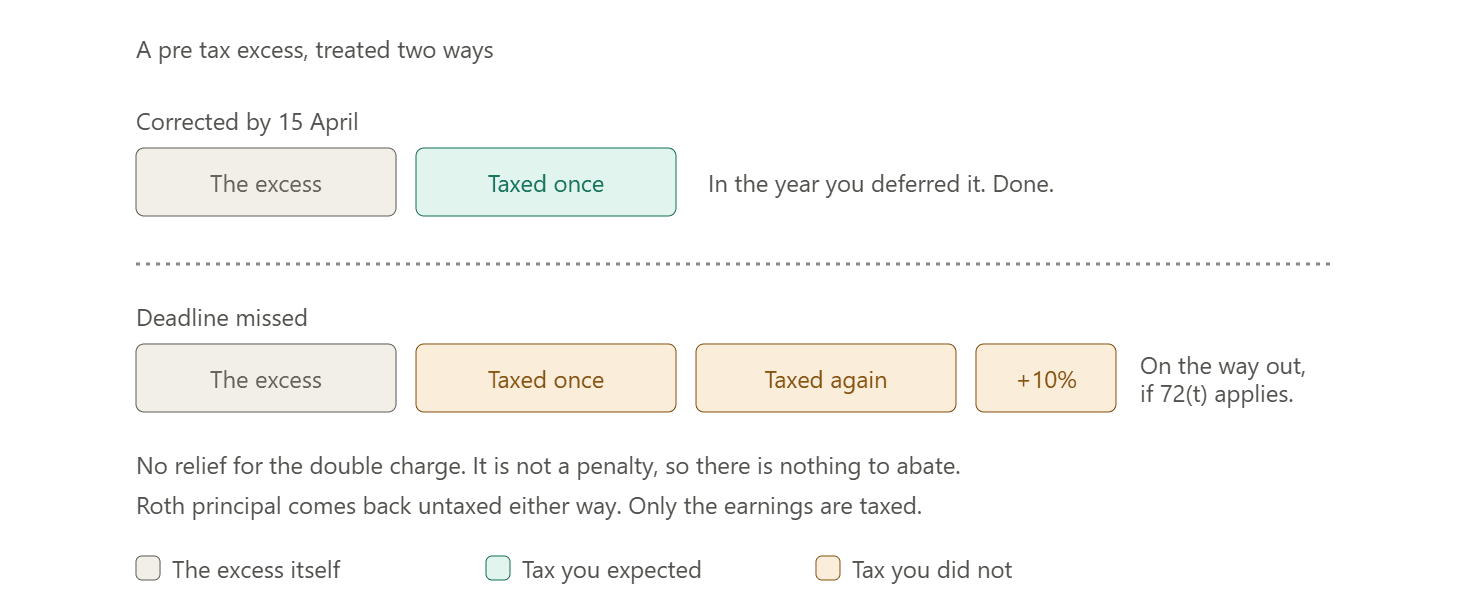
image.png

Serving NYC for 12+ years | 150,000+ returns filed | 5 star rated on Google and Yelp | Open evenings and weekends

"We do work 7 days a week during tax season. And when we don't have tax season, I make sure to move around people's schedule so they can at least have some quality of life while being able to serve the clients when they need to be served." George Dimov, CPA

"I've been a client of Dimov Tax for several years, and their service has consistently impressed me. The team is proactive and always quick to respond, even during the busiest times of the year." Moto H., Google review

[ Fix it before April 15 ] Send us both W-2s and your latest plan statements. We will work out whether you are over, by how much, and which plan should return it. Call (212) 641-0673 or send the contact form. No charge for the conversation.

Reviewed by George Dimov, CPA, New York, NY. Serving clients in all 50 states, 15+ years advising on retirement plan contributions, corrective distributions, and the returns that report them. President of George Dimov, CPA, a New York City firm serving clients across the five boroughs and nationwide.


No cost to start

Questions about your specific situation?

Fifteen minutes with a CPA who handles this every week. We will walk you through your options — no sales pitch, no obligation.

Client reviews

What our clients say

“George has prepared and maintained the corporate accounting and provided consultant services for my company for a number of years. He has always done an outstanding, professional and courteous job. I feel that his rates are very fair and he provides a great value for the cost.”
Alfonso V.
“Excellent service and very professional. George and his team have been handling my business taxes for years and I couldn't be happier with the results. They are always available to answer questions and provide expert advice.”
Michael R.
“I've been working with Dimov CPA for both personal and business taxes. Their attention to detail and knowledge of tax law has saved me thousands. Highly recommend to anyone looking for a reliable CPA in NYC.”
Sarah L.

Ready when you are

Let's talk about the next step

A CPA will review your situation and give you a straight answer. No commitment, no jargon.

Google ReviewsYelp ReviewsThumbtack Top ProTaxBuzz Reviews